Made in the UK



Are LED Light Bars Road Legal? UK & EU Regulations Explained
When installing an LED light bar or planning an auxiliary lighting set up for their vehicle, one of the most common questions we receive from our customers is:
‘How do I make sure my lights are road legal?’
In Europe (and some non-European countries such as Canada, Australia, New Zealand, Japan etc) the lighting on a vehicle during the “Whole Vehicle Type Approval” process must comply with UNECE Regulation 48.
This regulation states exactly what lights must be fitted on the vehicle when it is first produced at the factory, and where those lights should be positioned. In the case of auxiliary high beam driving lights, UNECE regulation 48 allows for two optional lamps to be installed, in addition to the two which are required. This is why sometimes vehicle makers will add extra spotlights as part of the original vehicle design and homologation.
But crucially, after a car leaves the factory and is delivered to the dealership for onward sale, then national regulations apply, and so there is flexibility at that time for further or different lamps to be installed alongside the lamps which were fitted by the vehicle maker.
Examples of how national regulations can deviate from UNECE Regulation 48:
Sweden: There is no limit to the number of lights which may be fitted, and no limit to the brightness of those lights (this follows a safety push from Swedish authorities in the 1970’s, where they were seeing high numbers of road deaths from poor visibility on rural roads.. Additional lighting continues to deliver safety benefits in the Driver versus Moose scenario).
United Kingdom: Road Vehicle Lighting Regulations (RVLR) is the regulation which is followed by inspectors assessing the car each year during the annual inspection (the “MOT”). This regulation allows for any number of optional main beam headlamps to be fitted, and no limit to the maximum intensity of the optional extra lamps.(https://www.legislation.gov.uk/uksi/1989/1796/schedule/5/made)
Finland: Optional lamps may be fitted, including “Single lamps” on the centreline of the vehicle, however, the total brightness (intensity) of all main beam driving lights needs to stay under specific limits (more on this later).
France: French authorities follow the Code de la route, and it allows for either two or four main beam driving lights to be installed on a vehicle. But in the case of France, there is no maximum intensity value which needs to be considered.
Poland, Switzerland, Germany, Austria (and others…): Authorities in a large number of countries choose to align their national regulations with UNECE regulation 48 for their local regulations, which means that optional lights may be fitted, but must always be in pairs, and like Finland, the total intensity of those extra main beam lights must stay within certain limits.
‘ OK Great, so what do I do if i'm in a country which follows UNECE Regulation 48 for it's national lighting regulations? What do I need to think about? '
UNECE Regulation 48 (09 series of amendments from September 2024) limits the number of extra lights to “one or two additional pairs” (i.e. 6 lamps total, when considered with the mandatory pair of lights which are fitted by the vehicle maker). Additionally, UNECE Reg 48 uses a classification and reference value system to control the total brightness of the maximum 6 lights which may be installed.
Each driving light, including both factory-fitted headlights and any auxiliary lamps, is assigned a classification and reference number based on its intensity. Firstly, only lamps of class B or RA may be fitted as additional optional main beam lights. These are marked with an “HR” or an “RA” on the lens of the product. Secondly, relating to the reference value system, the combined intensity reference value of all driving beams must not exceed 100.
How classifications fit in:
Alongside installation rules, UNECE regulations (specifically R149) classify driving lights based on their intensity, beam pattern and performance. In most cases, the regulation puts lights into the following categories: Class A driving lights, Class B driving lights, or Class RA supplemental driving lights. Class RA lights are only permitted for use simultaneously with other lamps of a higher power class (type A or type B).
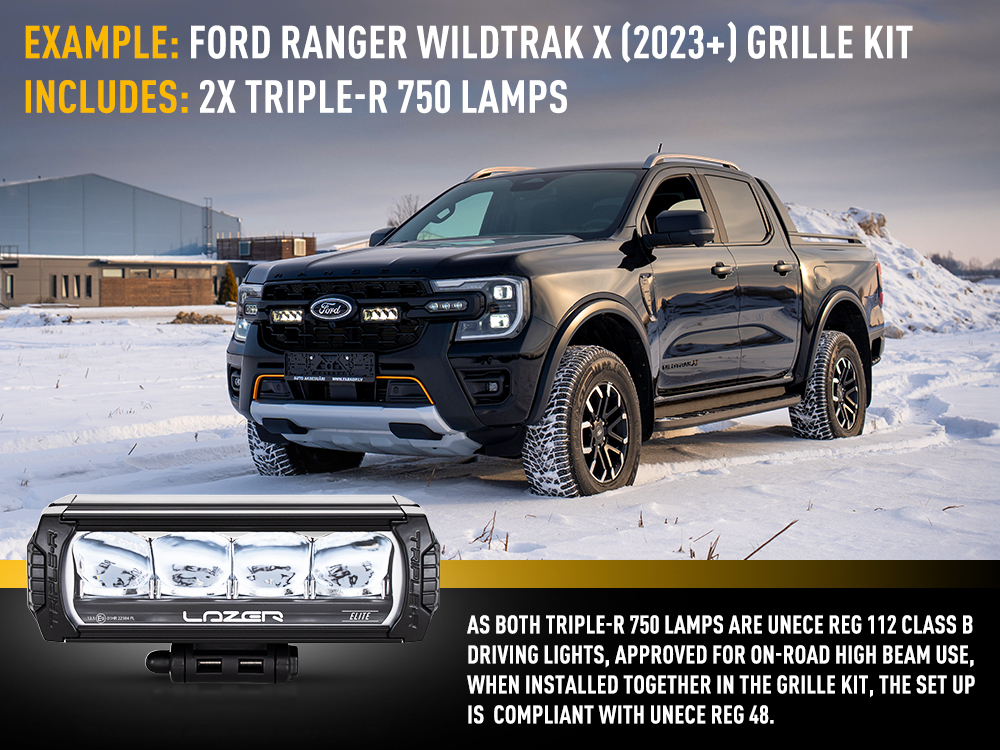
Class B: At Lazer, most of our high-performance LED driving lights and light bars are approved as Class B driving lights. Class B lights are: High-power driving beams, designed to supplement the vehicle’s main beam headlights. Often Class B driving lights have slightly higher reference values due to their higher output.
Class RA: A more recent update to Regulation 48 (September 2024) also allows the installation of Class RA driving lights, which are classified as supplemental driving beams used alongside existing headlights. Due to their lower intensity, these lights often have lower reference values.
Class A: Some lamps may be certified as Class A (Marked “R” on the lens) driving lights instead. This classification usually only applies when a lamp does not meet the output limits required for Class B approval. For example, our ST2 lamp is approved as a Class A driving light, placing it within a different regulatory category.
‘ What does an 'E-Mark' on an LED Light Bar Mean? ’
If an LED light bar carries an E-mark, it means the lamp has been tested and certified under UNECE regulations. The certification confirms the product meets strict standards for:
-
Beam pattern performance
-
Light intensity
-
Durability
-
Environmental resistance
-
Electrical safety
A typical marking may look like:
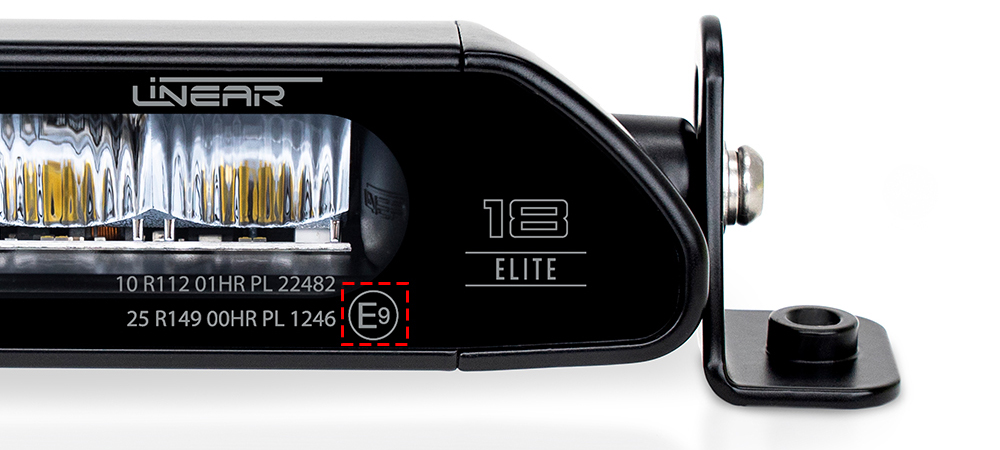
The number indicates which country issued the certification approval. For example: E9 = Spain. Spain is one of several authorised testing authorities that certify automotive lighting products under UNECE regulations.
The other additional markings can also provide useful information:
PL Marking: the PL marking indicates the lamp uses a plastic lens. Plastic lenses must pass extensive testing to ensure they resist scratches, maintain clarity over time and do not discolor from UV exposure.
HR Marking: the HR marking indicates the lamp is approved as a Class B driving light. If the marking simply shows R, the lamp is typically approved as a Class A driving light.
UNECE Regulation Numbers: You may also see references such as: R149 / R148 / R112 / R7 - these numbers identify the specific UNECE regulation under which the product has been approved. Each certified lamp also carries a unique certificate number, which allows inspection authorities to verify the approval documentation.
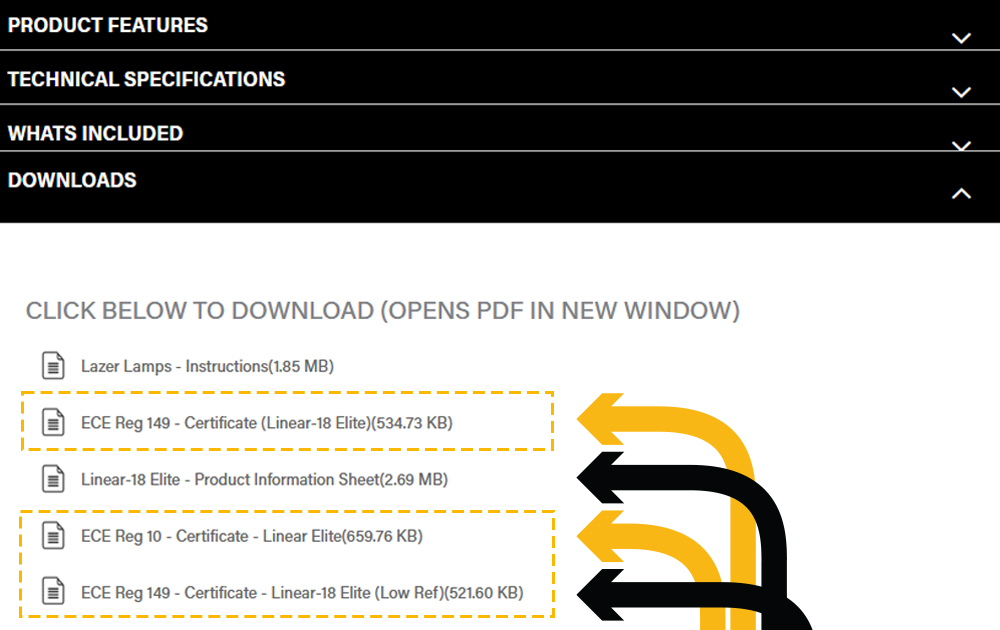
To help our customers verify product compliance, E-mark certificates can be downloaded from our product pages, contained with the downloads section. We provide the first three pages of the certificate, but If a full report is required, we can provide it on request.
Reference Numbers & Flash-to-Dim Technology
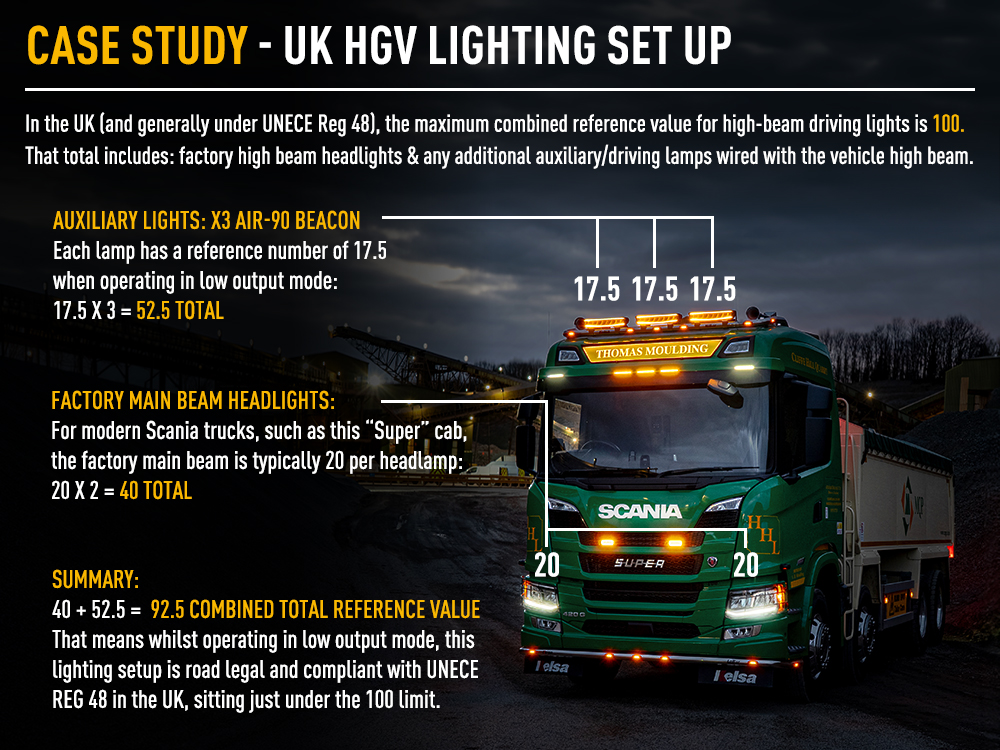
Every approved driving light is assigned a reference number (or reference mark). This number represents the maximum peak intensity of light emitted from the lamp, typically measured at a distance of 25 metres. The reference number helps ensure the combined output of all driving lights on a vehicle remains within legal limits. In some European countries, the maximum combined reference value permitted for road use is 100. This total includes the vehicle’s factory headlights as well as any additional driving lights fitted - for example:
- If a vehicle’s standard headlights have a reference value of 20 each, the total from the headlights alone would be 40.
- This would leave 60 reference points available for additional driving lights.
- A driver could therefore fit four auxiliary lights with a reference mark of 15 each, reaching the maximum permitted value of 100.
At Lazer we design many of our lamps to actualy have relatively low peak intensity reference numbers, which helps drivers stay within these limits even when fitting multiple auxiliary lights. This is possible because our lights spread or distribute the available light more efficiently, producing a wide, smooth, and homogenous beam pattern rather than concentrating all intensity into a single narrow hotspot.
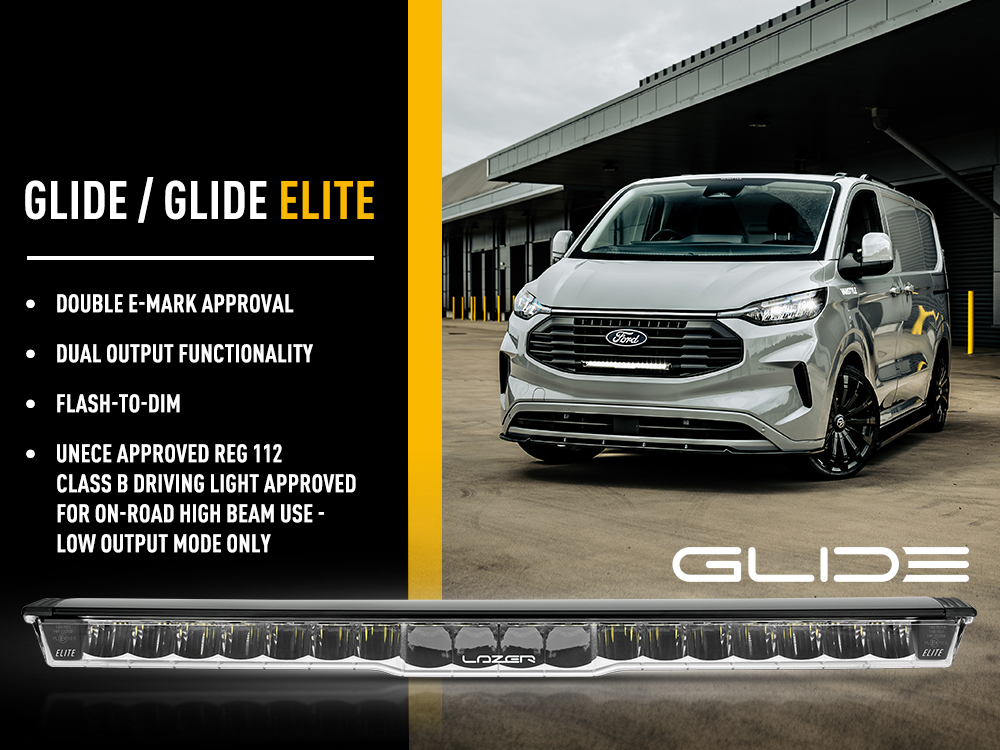
Alongside this, many Lazer products feature dual output functionality, meaning they have a low output / road-legal output mode, and a high output / Boost Mode - designed for use off-road or in regions where lighting restrictions do not apply. More recently our products, such as Glide and the Sentinel PL2 range, also feature our new innovative Flash-To-Dim technology, which allows for a much easier switch between the output modes whilst driving. The dual output functionality and Flash-To-Dim technology help achieve road-legal certification, as during the approval process, the lamp is tested in low output / road-legal mode, which reduces the light output to achieve the lower reference value.
Drivers travelling in countries with strict regulations should operate the lamp in road-legal mode. Then when driving off-road, or in regions such as UK, Norway or Sweden where intensity limits don’t apply, drivers can activate boost mode for maximum visibility. This dual-mode functionality ensures the lighting system can remain fully compliant for road use, while still offering the high-performance illumination expected from advanced LED driving lights.
What is a Double E-Mark?
Some LED light bars are approved with what is known as a double E-mark. This occurs when a lamp contains two internally separate LED modules, each approved as an individual driving light. Although the product appears as one single lamp, internally it functions as two certified lighting elements - allowing it to be compliant with UNECE Regulation 48.
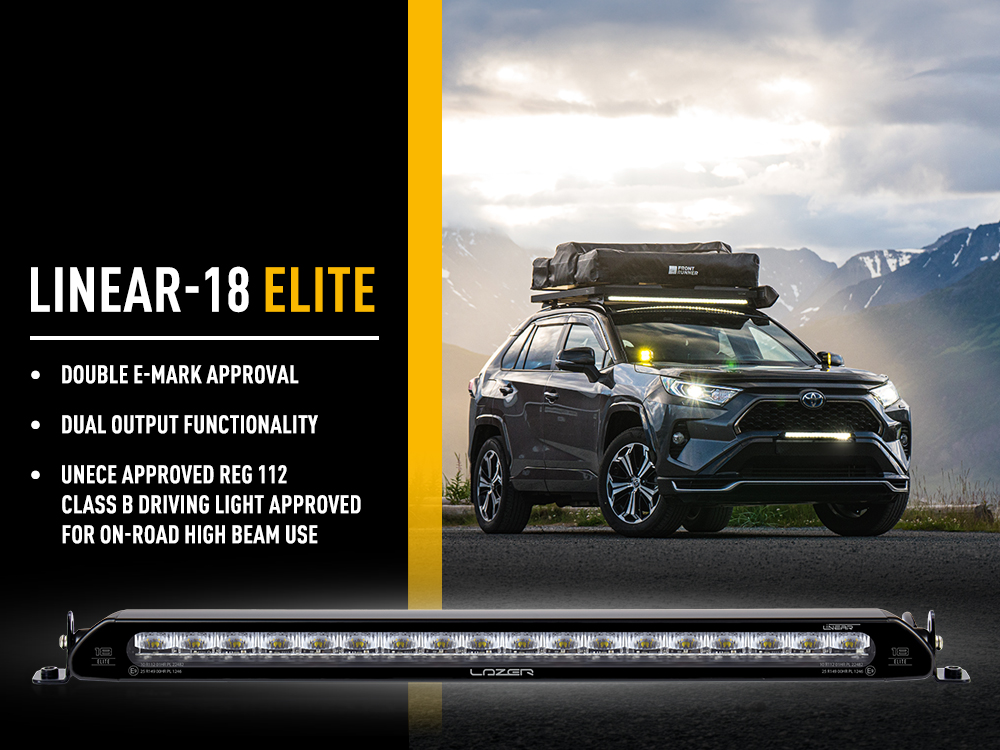
Example: Linear-18 Double E-Mark Approval
A good example of this is the Linear-18 LED light bar. Within the lamp, the left and right sections are identical, but they are certified as two separate lighting modules. When the lamp is switched on, both sides illuminate simultaneously. However, during the certification process they are approved independently, which allows the lamp to carry a double E-mark approval. This design enables us to maximise performance of the product while still meeting regulatory limits.
Example: Glide Double E-Mark Approval
The Glide driving light is another example of a double E-mark lamp, but with a slightly different configuration. In this lamp, the beam pattern from the left side differs slightly from the right side. This happens because the centre section of the lamp contains spot LEDs, with the middle four reflectors designed specifically to produce a long-range beam, whilst the wide reflectors produce an expansive wide beam.
As a result, the lamp produces a non-symmetrical beam pattern, meaning the left and right elements are tested separately during certification. When reviewing the certification documentation for Glide: one variant represents the right-hand element and one variant represents the left-hand element. Both elements together achieve a reference value of 12.5, allowing the lamp to receive its double E-mark approval.
Example: Why Glide Roof Pods Use a Single E-Mark
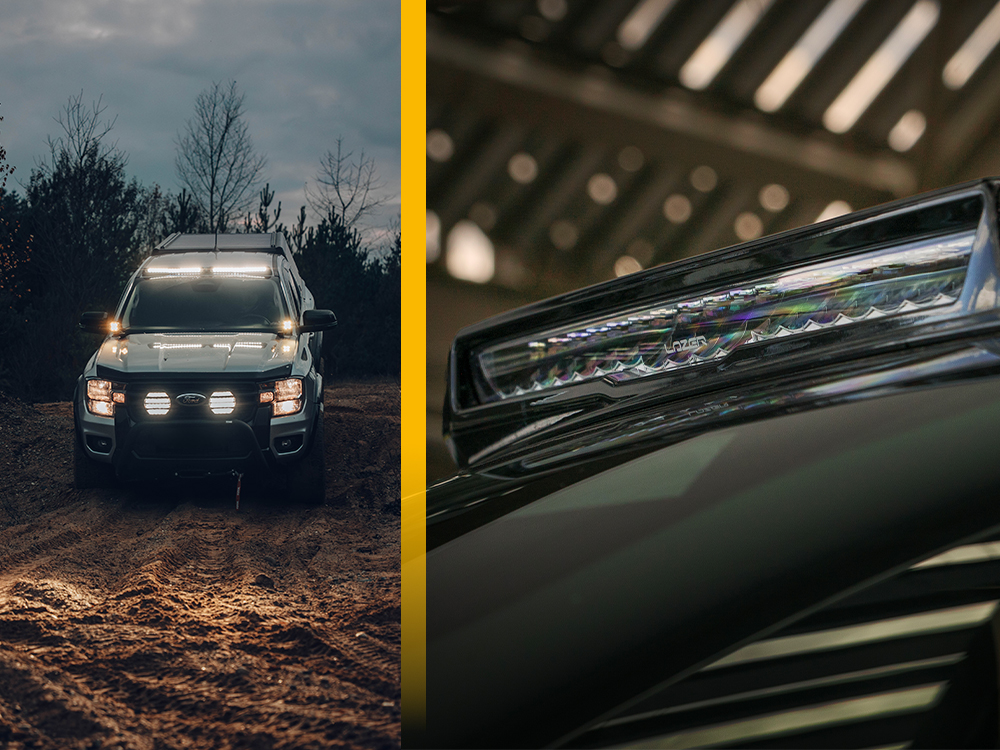
When the Glide lamps are integrated into roof pods, such as those we developed for the Volkswagen Amarok and Ford Ranger / Ranger Raptor, the certification changes. Because UNECE Regulation 48 allows only allows four additional driving lights, a lamp with a double E-mark counts as two lights.
If two double-E-marked lamps were mounted on the roof, the installation would be at the limit of how many extra lamps can be fitted, thereby preventing the fitment of a Lazer grille kit, which we would expect sme customers may want to supplement their system. This is particularly important in countries such as Germany, Switzerland and other EU markets where lighting regulations are strictly enforced. The Glide lamps used in these roof pods are recertified as single E-mark units. The revised approval number is shown on the lamp infill pieces and on the product label on the underside of the lamp to clearly identifiy the lamp as single E-mark certified when used in the roof-mounted system.
Summary: Staying Road Legal with LED Light Bars & Auxiliary Lights
Understanding LED driving light regulations and certification can seem complicated, but the markings on each product provide clear evidence of compliance.
Installing LED light bars or auxiliary driving lights can significantly improve nighttime visibility, but ensuring your setup complies with UK and EU road regulations is essential. To keep your installation road legal, always check:
- The lamp carries a valid E-mark certification
- The correct driving light classification is used
- The number of auxiliary lights fitted does not exceed legal limits
- The reference numbers remain within regulation limits
By selecting properly certified lighting products (such as ours) and installing them correctly, you can enjoy the benefits of high-performance LED lighting while staying fully compliant with road regulations.
If you have any questions about certifications, vehicle fitment, or lighting regulations, feel free to get in touch with our team directly via: sales@lazerlamps.com
FAQ: Frequently Asked Questions About LED Light Bar Laws In the UK & Europe
‘Are LED light bars legal in the UK / EU?’
Yes, LED light bars can be road legal in the UK, provided they comply with the national vehicle lighting regulations. In the strictest countries such as Germany, Switzerland, and Eastern Europe countries, to remain road legal, the lights must:
- Carry a valid E-mark certification
- Be wired to operate only with the vehicle’s main beam
- Not exceed the allowed reference number limits
- Be limited to two additional pairs being fitted (6 lamps total).
What does E-mark mean on LED lights?
An E-mark (i.e. E9 with a circle round it, combined with the letters A, B or RA) confirms that a lighting product has been tested and certified under UNECE automotive lighting regulations as a driving beam product. The certification ensures the product meets requirements for:
- Beam pattern performance
- Light intensity limits
- Electrical safety
- Environmental durability
The number beside the E-mark identifies which country issued the certification. For example: E9 = Spain. Each certified light also carries a certificate number, which allows authorities to verify the approval documentation. Note that a CE mark is different, and is simply a statement of fact from the manufacturer is “Safe for onward sale”, but this doesn’t have any meaning in relation to auxiliary lights or vehicle road use.
‘What is the difference between Class A, Class B and RA driving lights?’
Driving lights are classified according to UNECE regulations. Each classification determines how the lamp can be used and installed legally.
Class B Driving Lights
- High-power driving beams
- Designed to supplement a vehicle’s main beam headlights
- Common for high-performance LED light bars
Class RA Driving Lights
- Supplemental beams which may only be used in combination with class A or Class B (or existing) headlights
- Introduced in updates to UNECE Regulation 48, September 2024.
Class A Driving Lights
- Lower output driving lights that do not meet the limits required for Class B approval
‘How many auxiliary driving lights can you fit to a vehicle in Europe?’
Under UNECE Regulation 48, vehicles are generally permitted to install: Four additional Class A, or Class B driving lights, or four Class RA supplemental driving lights. These must operate alongside the vehicle’s high beam headlights. This is why some lighting systems, particularly roof-mounted lights, are designed carefully to ensure they do not exceed the maximum permitted number of driving lights. However, it is also important to consider reference numbers and combined reference value permitted for road use in your region.
‘What are reference numbers on driving lights?’
Every approved driving light is assigned a reference number (or reference mark). This number represents the maximum peak intensity of light emitted from the lamp, measured at a distance of 25 metres. The reference number helps ensure the combined output of all driving lights on a vehicle remains within legal limits. In some European countries, the maximum combined reference value permitted for road use is 100. This total includes the vehicle’s factory headlights as well as any additional driving lights fitted.
If a vehicle’s standard headlights have a reference value of 20 each, the total from the headlights alone would be 40.This would leave 60 reference points available for additional driving lights. A driver could therefore fit four auxiliary lights with a reference mark of 15 each, reaching the maximum permitted value of 100.
Lazer Lamps auxiliary lights use dual output technologies such as Flash-to-Dim, which allows the lamp to operate at: Reduced output for road use / Higher output for off-road or unrestricted environments. The reduced output mode allows the lamp to achieve a lower reference number and therefore help stay within the combined reference value.
‘Are roof-mounted LED light bars legal in Europe?’
Roof-mounted LED light bars can be road legal in Europe if they comply with UNECE regulations. However, roof lights must still follow the rule limiting vehicles to four additional driving lights and a maximum intensity of reference 100. For this reason, some roof lighting systems, such as Lazers VW Amarok & Ford Ranger / Ranger Raptor roof pod kits, are certified as single E-mark units rather than double E-mark lamps to allow customers to also fit two extra lamps in the grille area on the same car. For longer light bars running along the top roof, they are certified with a double E-Mark to remain road legal, for example - the linear-36 standard light bar, since UNECE Reg 48 requires lights to be mounted in “pairs”.
‘Where can I check if an LED light bar is certified?’
Certified LED driving lights include an E-mark and approval number on the lens or housing. You can usually verify certification by:
- Checking the E-mark on the product
- Looking up the approval certificate
- Downloading the documentation from our website - available on the product page - downloads section
'I Need Help Choosing Road-Legal LED Driving Lights?'
Choosing the right E-mark approved LED light bar or auxiliary driving lights ensures you get maximum visibility while staying compliant with UK and EU road regulations. However there are also a range of different factors to consider, including style, performance, integration and budget, If you're unsure which lights are suitable for your vehicle or driving needs, our team is always happy to help - sales@lazerlamps.com
Position Lights / Side Lights
Like high beam driving, the fitment of optional front position lights (after the vehicle is delivered to the dealership) is depending on the national regulations in each country. In the UK for example, there are requirements regarding the position of the two mandatory position lights which come pre-fitted to the vehicle by the vehicle maker, but the only requirement for optional position lights is that they must be “white in colour, or yellow when incorporated in a headlamp which is only able to emit a yellow light”. Please check the national regulations in your country, when deciding whether to connect up the integrated Position Lights which may come with your Lazer driving lights.
Pedestrian Protection regulations
There are specific exemptions for auxiliary lighting, in relation to Pedestrian Protection regulations, since lighting is recognised as providing an important part in road safety and the prevention of accidents on rural roads at night. Pedestrian protection regulations (eur-lex.europa.eu/legal-content/EN/TXT/PDF/?uri=CELEX:32019R2144) state that it is permitted to have “frontal protection systems” which weigh less than 500 grams, and which protect the vehicle’s lights (see extract below). Our Grille kits fall in to this category, since they are serving to mount and protect the additional lamps which are approved for fitment according to the UNECE and local regulations.
To stay updated with exciting news and new product launches, follow Lazer's journey through our social media channels:
Instagram - https://www.instagram.com/lazerlamps/
Facebook - https://www.facebook.com/Lazerlamps/
TikTok - https://www.tiktok.com/@lazerlamps
YouTube - https://www.youtube.com/user/Lazerlamps